Four functions of AI
Today's consumer-facing AI sorts into a ladder of autonomy — Informs → Analyzes → Advises → Acts. Incumbents cluster in the first two; fintechs appear across all four.
Corporate Insight Research · Synthesized for Leadership by XD/Chris Metzner
Two-thirds of consumers already assume their financial provider uses AI — and their default read is negative. This briefing maps where the industry stands today, what the leaders are getting right, and where the real opportunity lies.
01 · Executive Summary
AI has powered financial services for a decade, but generative AI reset expectations overnight. Fintechs sprinted ahead; incumbents held back for good reasons. The urgent problem now is that consumers are skeptical, and much of what firms have already shipped underperforms.
assume their financial & insurance providers already use AI moderately or extensively
are more concerned than excited about AI in society — vs. just 19% more excited
have used AI — nearly a third (31%) use it multiple times per day
disconnect from a support chat the moment they believe they're talking to an AI
Today's consumer-facing AI sorts into a ladder of autonomy — Informs → Analyzes → Advises → Acts. Incumbents cluster in the first two; fintechs appear across all four.
Digital-native challengers ship the most sophisticated AI — concentrated in trading-adjacent verticals where data is rich and risk tolerance is high.
Consumers use AI heavily but distrust it in financial settings. They read corporate AI as cost-cutting until proven otherwise.
Transparency, an easy path to a human, and human review of consequential decisions consistently raise consumer comfort.
Half of tested automated-investing & retirement VAs failed on a single-word typo. Fix what's deployed before building what's next.
Only a minority pick a firm because it offers AI. Near-term value is deepening existing relationships and trust.
“They all say, ‘we use AI to better serve you.’ Okay — prove it. Actions speak louder than words.”
— Jessica I., consumer interview participant
02 · The AI Landscape
This framework measures function, not quality. A tool that informs well isn't inferior to one that acts — the right tier is the one that serves your clients without eroding trust.
Information only — the user interprets
Examples: most incumbent VAs; Robinhood Digests, Coinbase & Webull summaries
Insights & recommendations — the user decides
Examples: BofA Erica, Wells Fargo Fargo, Schwab Portfolio Insights, Citi Sky; Robinhood Cortex, Public Alpha
Specific advice — the user executes
Examples: Origin, Magnifi, AInvest; Vanguard Digital Advisor AI (pilot)
Strategy co-pilot — the AI executes
Examples: Composer, Public, Interactive Brokers, Robinhood, eToro, Gemini — no incumbents
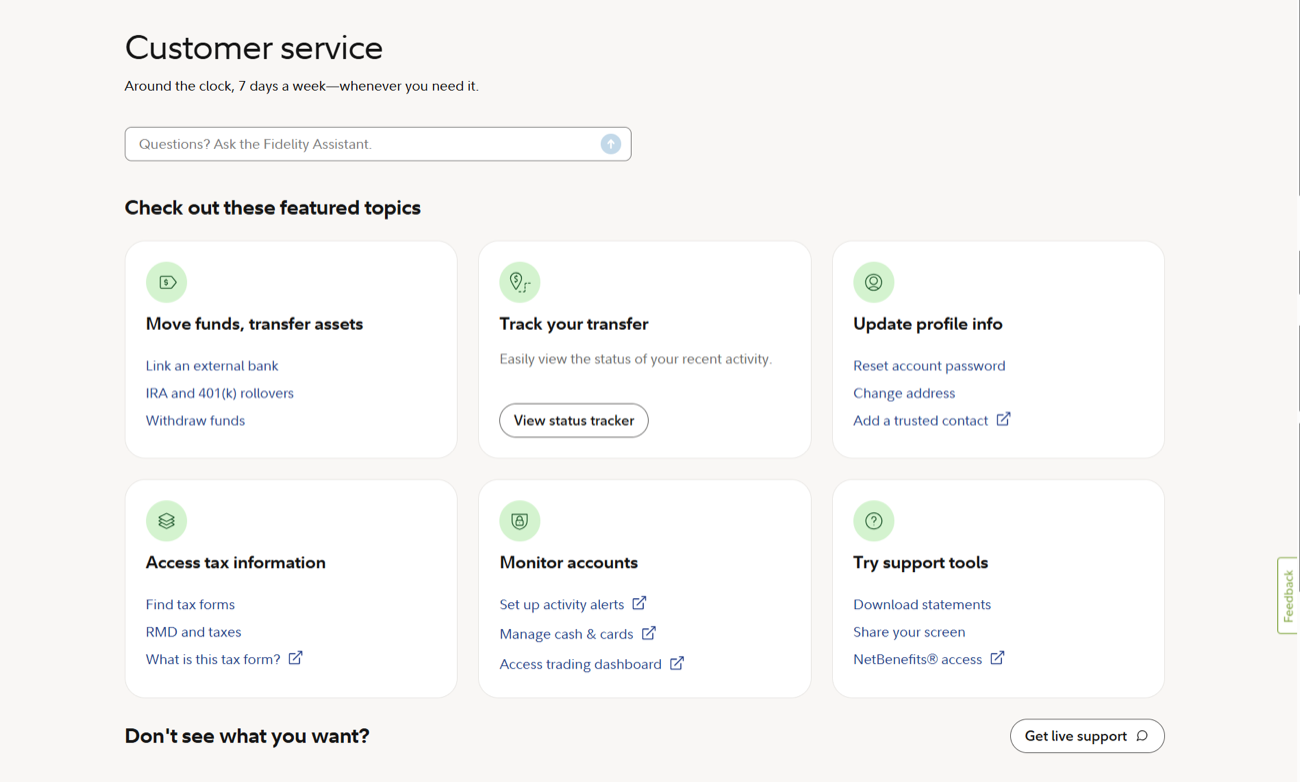
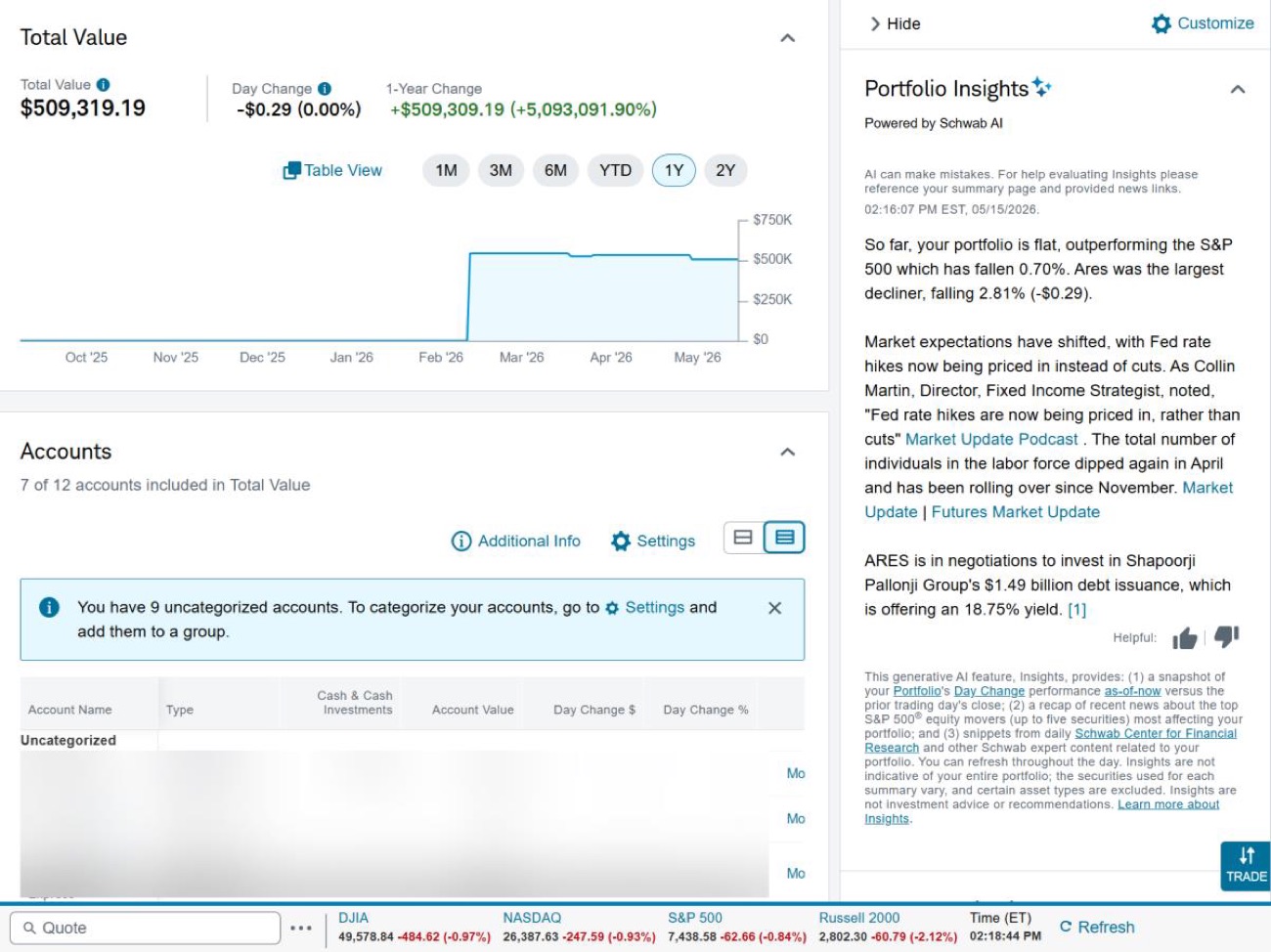
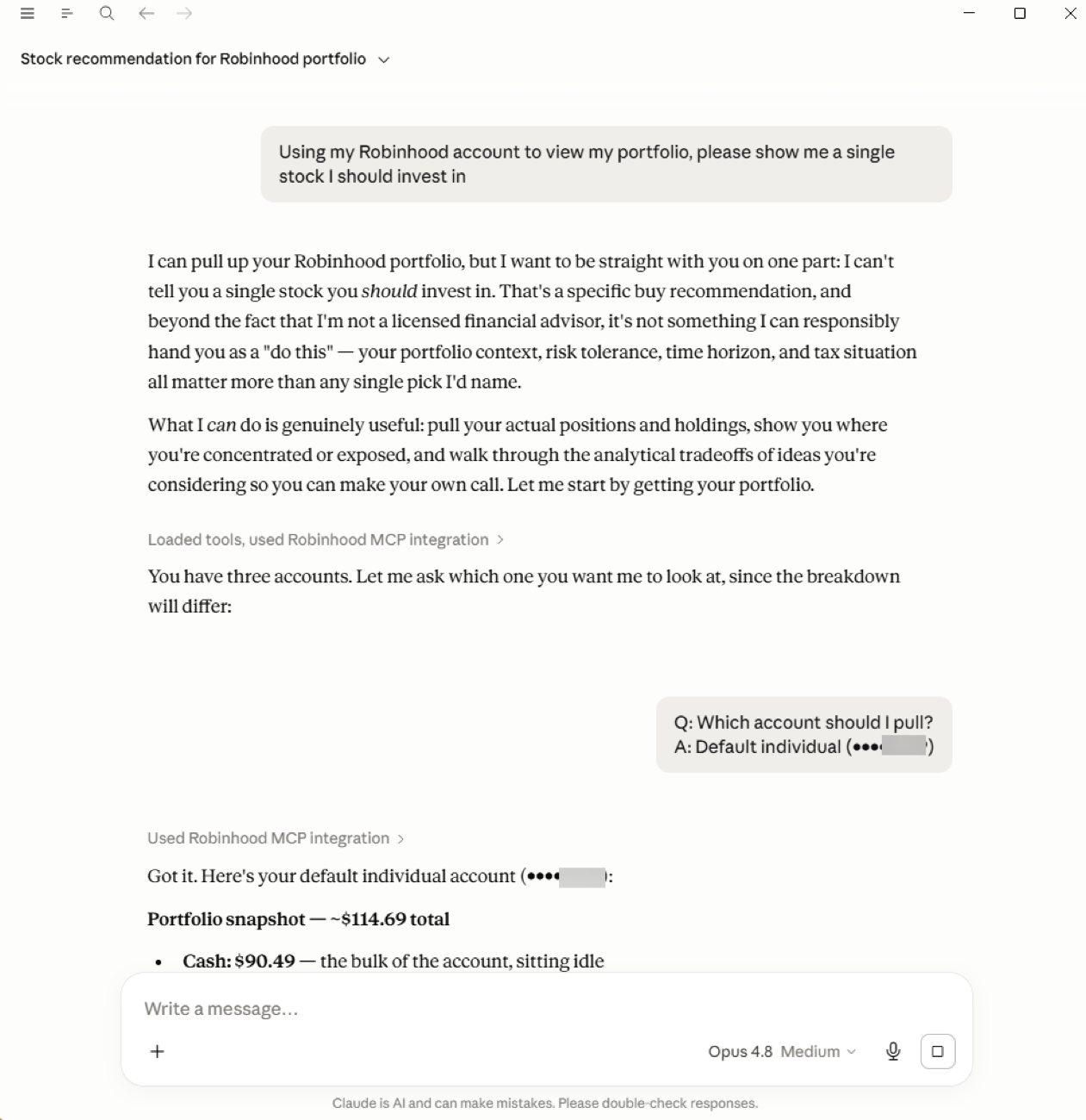
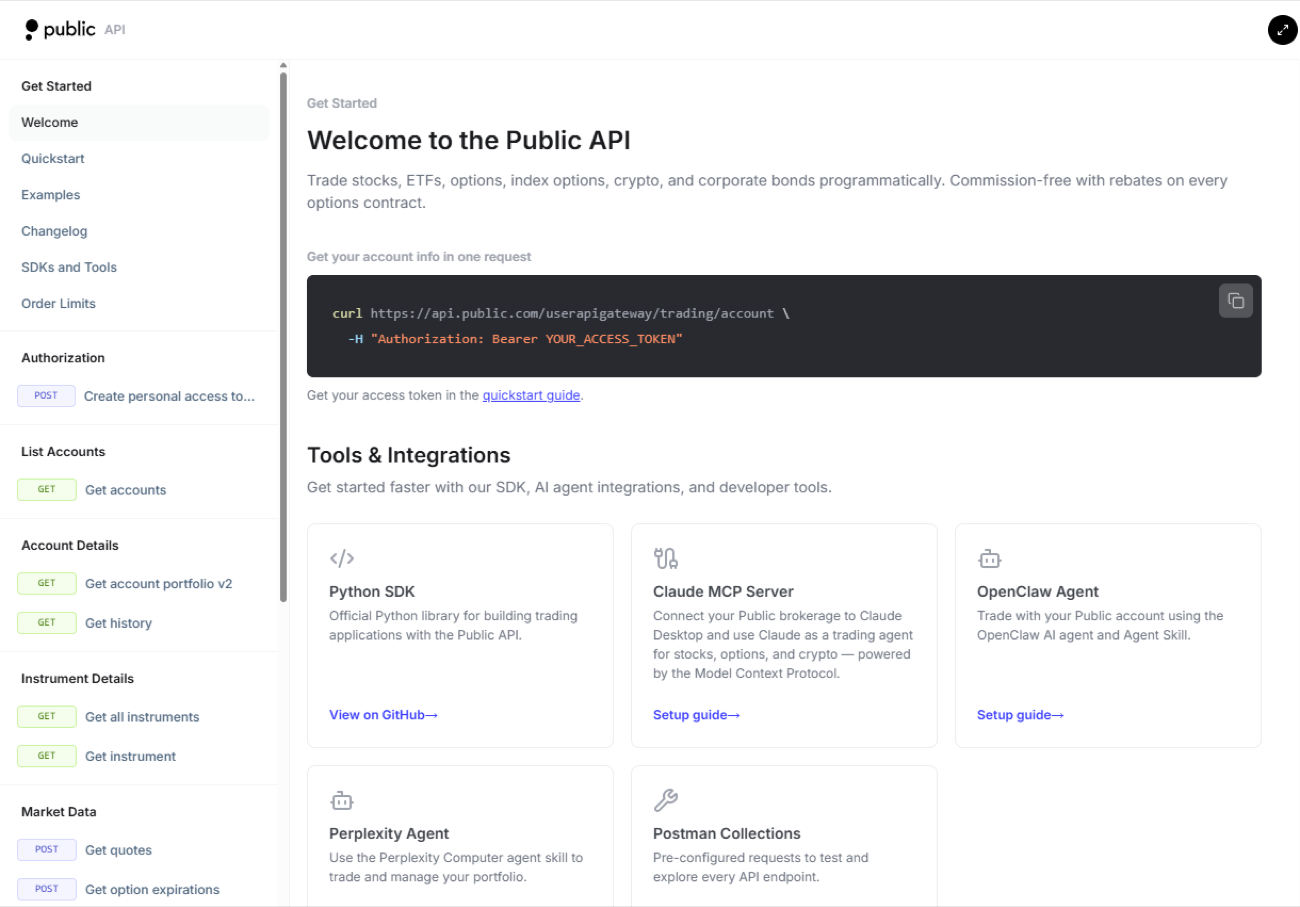
Representative screenshots from the Corporate Insight reports (internal use only). © Corporate Insight.
03 · Key Trends
Challengers deploy the most advanced consumer-facing AI — concentrated in crypto and brokerage, where data richness and risk tolerance reward bold moves.
The Analyzes tier is heating up: Schwab launched Portfolio Insights, Citi announced Sky, and Vanguard is piloting advice-grade AI for Digital Advisor.
“AI Acts” is emerging via API/MCP integrations — Public, Interactive Brokers, Robinhood, eToro and Gemini — but always with a human checkpoint or user-defined rules.
Popular LLMs like ChatGPT and Claude now set the bar for disclosure, error reminders and reasoning. Consumers expect the same honesty from their providers.
AI-forward firms like Origin position their tools as replacements for a human advisor — holistic, on-demand planning and personalized recommendations.
AI doesn't win new customers today. Its near-term value is retention — deepening trust with the customers a firm already has.
04 · Consumer Sentiment
Consumers use AI constantly, but that doesn't mean acceptance. In financial settings, skepticism is the baseline — and firms must design for an audience that is cautious at a minimum.
Share of respondents by overall attitude
Top associations — the dominant read is negative
Relative prominence shown; two of the top three associations are negative.
Excitement skews young — but concern persists across every age group
The higher the stakes, the less AI consumers want
of “more concerned” consumers disconnect once they sense an AI — and those who disconnect are far less satisfied (38% top-two-box).
“I see AI as a collaborator: they're the passenger; I'm the driver.”
— consumer interview participant
05 · The Three Comfort Drivers
These are not capabilities — they are execution choices within every firm's control. They matter most for the large middle group who are skeptical but still use AI.
Share of all respondents selecting each driver
Whether or not AI is actually present is irrelevant if users perceive it. Disclose AI across all contexts — and be honest about limits.
Doing it well: eToro Tori names its OpenAI models; Robinhood labels Digests “AI-powered, not advice.”
The single highest-rated comfort driver. Design escalation as a visible feature, not an occasional fallback.
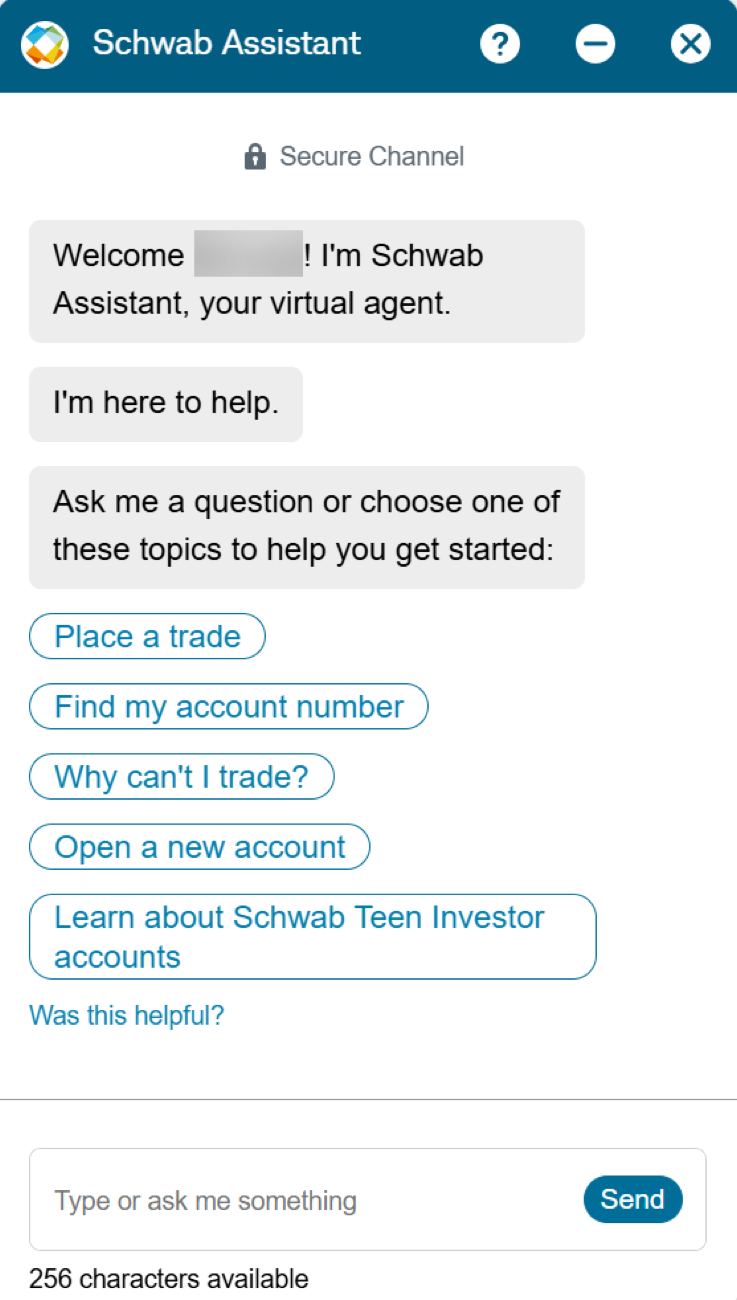
Doing it well: Schwab's persistent “Contact a CSR” button; SoFi's 24/7 handoff framing.
Consumers want to keep decision-making authority — especially as stakes rise. Surface the human element in the loop.
Doing it well: Lemonade auto-routes non-instant claims to humans; IBKR requires review before any AI-drafted order executes.
06 · What Firms Do Well
A handful of firms show what modern financial AI looks like — conversational, account-aware, transparent, and reliably connected to a human.
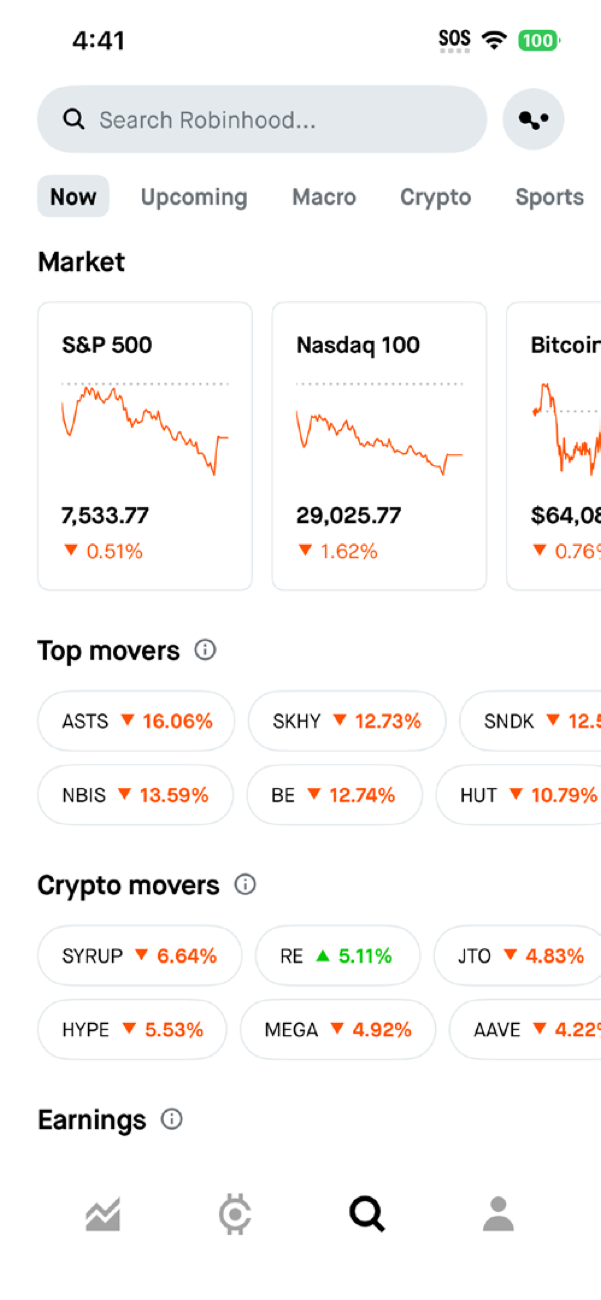
AI VA & Cortex — Analyzes
Replaced a deterministic assistant with a multi-turn, context-aware AI that draws on account holdings, watchlists and market data. Asks for clarification instead of restarting; keeps a full chat history.
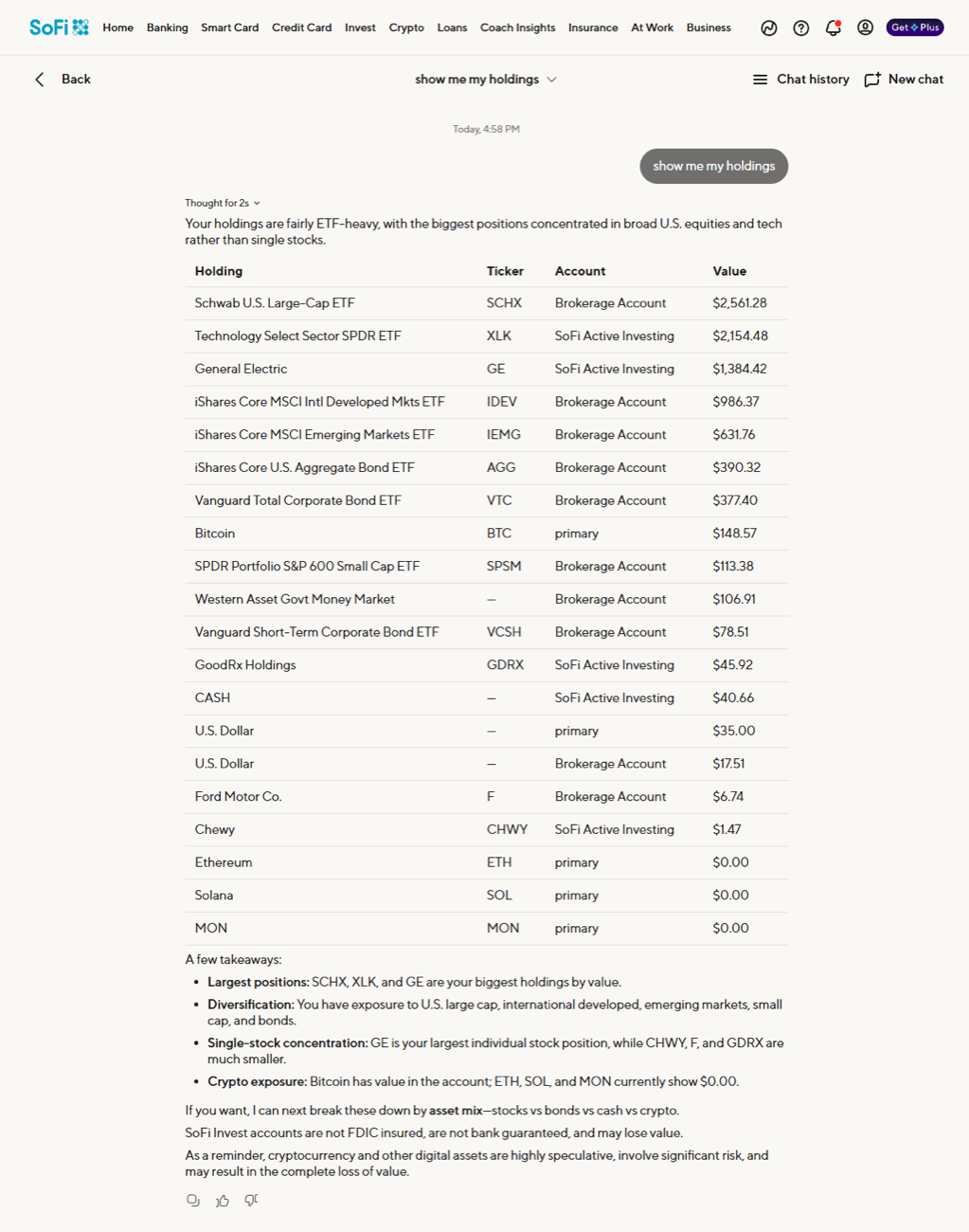
Generative VA — Analyzes
Conversational, strong language comprehension, retains context across a session. Surfaces portfolio concentration and a holdings table in-chat, and exposes a summary of its reasoning steps.
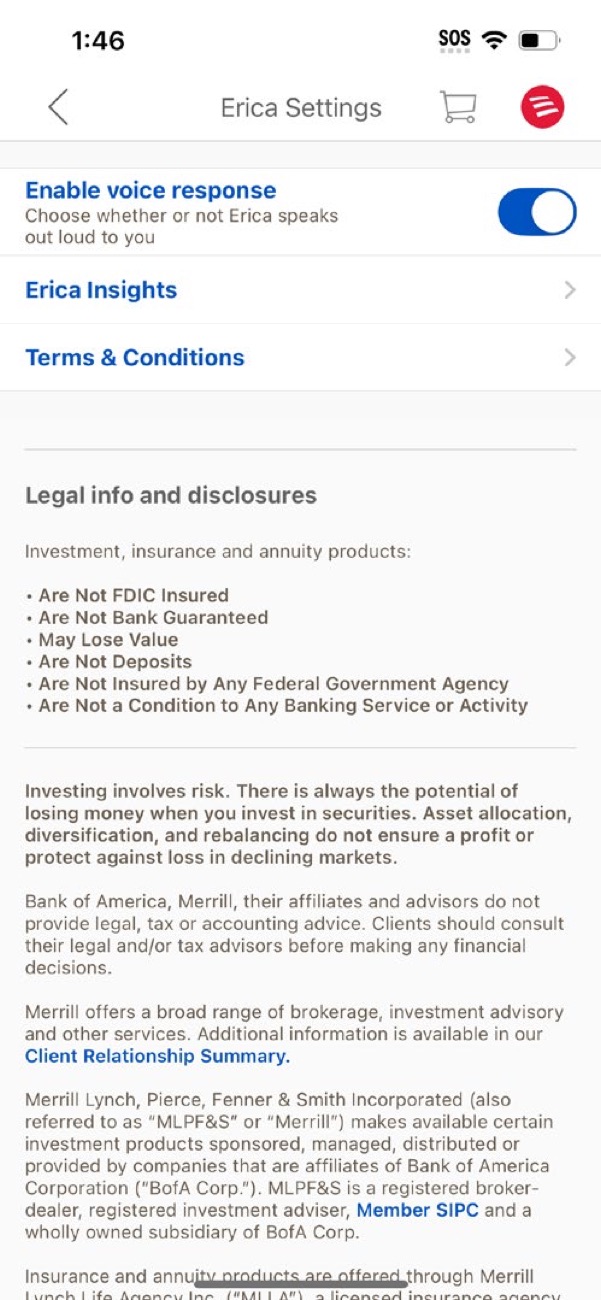
Mobile VA — Analyzes
Among the most capable mobile assistants: understands text and voice, handles informal phrasing, seldom errors, and reliably redirects when a request falls outside its scope.
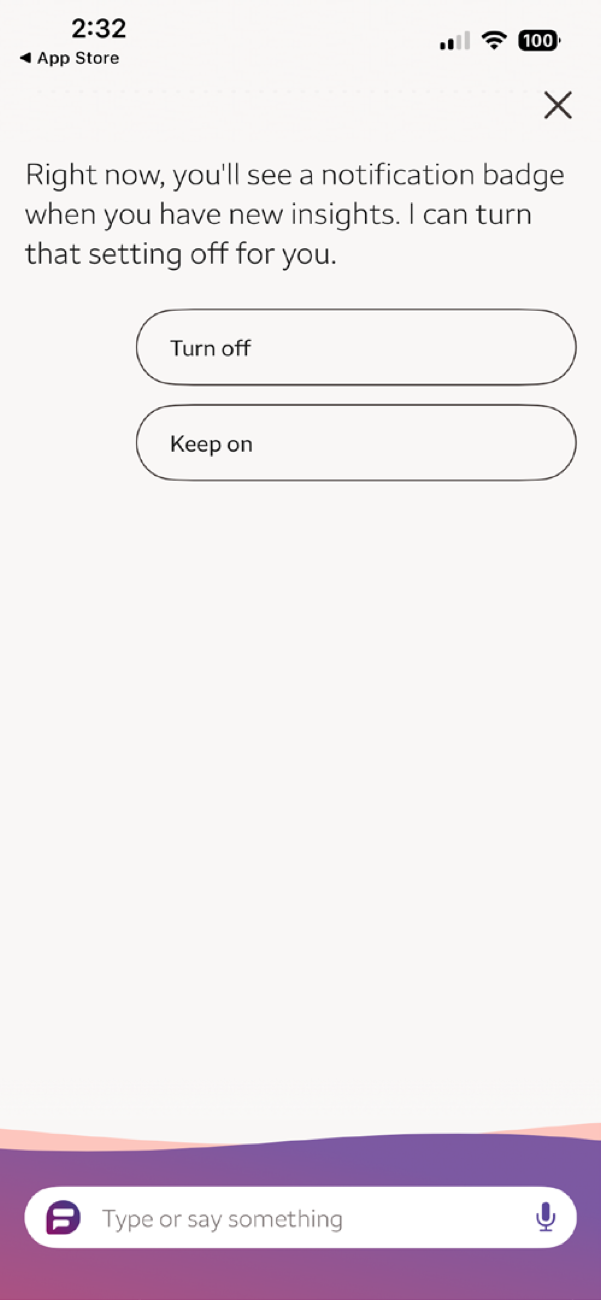
Mobile VA — Analyzes
Excels at everyday servicing with text/voice input and accurate speech-to-text. Integrates PFM insights like credit scores and spending, with a full Spanish-language version.
GenAI feature — Analyzes
The first incumbent client-facing GenAI feature at scale: a narrative snapshot of portfolio performance, curated SCFR commentary, and a news recap — with thorough disclosures.
Deterministic VA — Informs
One of the strongest deterministic chatbots: predictive text as you type, clarifying follow-ups, and availability on both the public and secure sites.
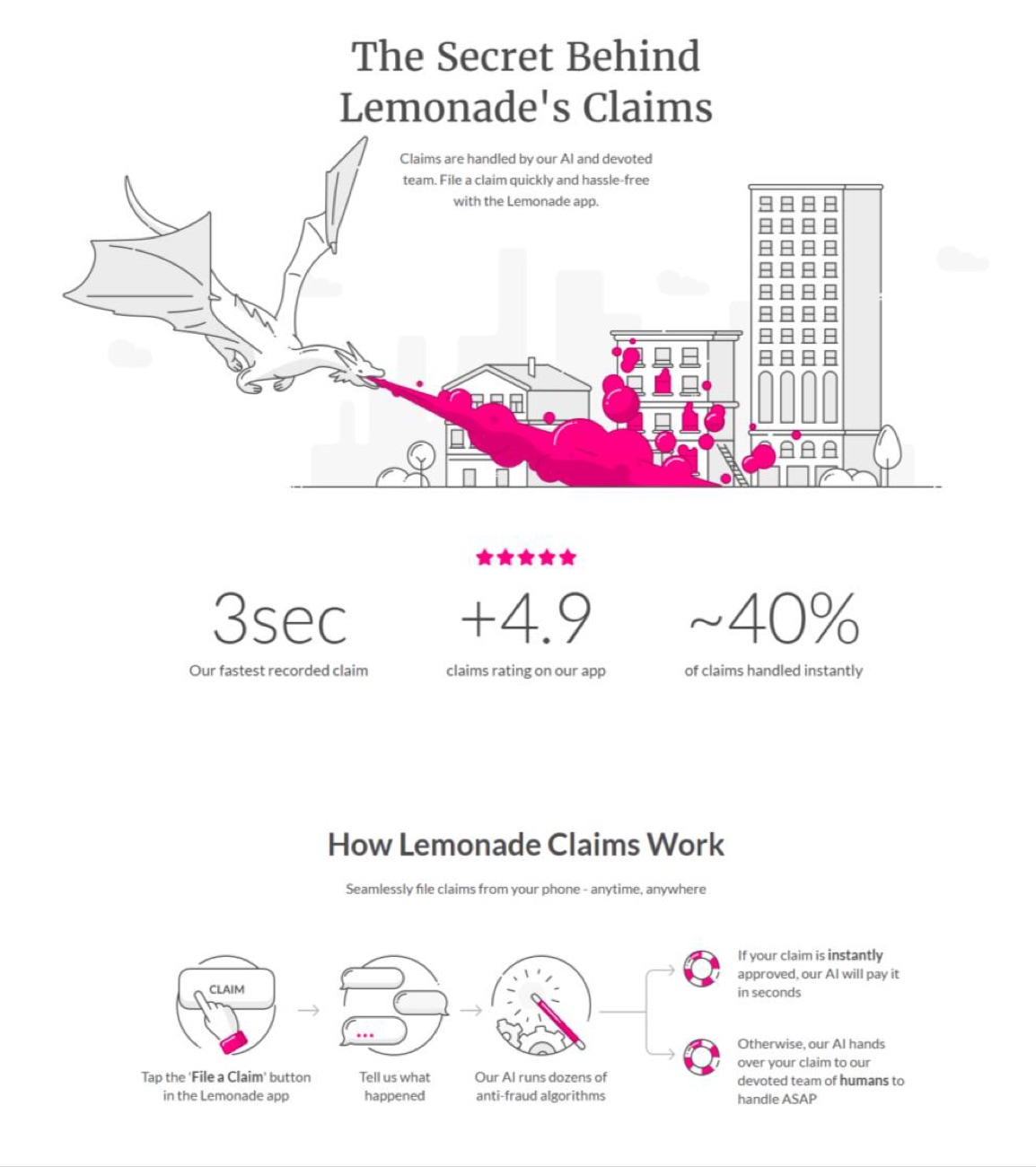
Claims VA — trust by design
Dual-routing claims: AI can approve instantly, but anything else automatically routes to a human before a decision — addressing the exact fear consumers voice about claims.
AI Advisor — Advises
The clearest example of the leading tier: an SEC-registered RIA whose multi-model AI gives specific recommendations grounded in linked accounts — with visible reasoning and disclaimers.
Product screenshots captured from the Corporate Insight reports (subscriber content, internal use only). © Corporate Insight.
For firms not ready for GenAI, these six practices define the best version of a rule-based assistant:
A smart routing layer with NLP that interprets typos, slang and varied phrasing.
Highest-volume tasks (password resets, updates) reachable in a single prompt.
Pair every redirect with a brief in-assistant, step-by-step sequence.
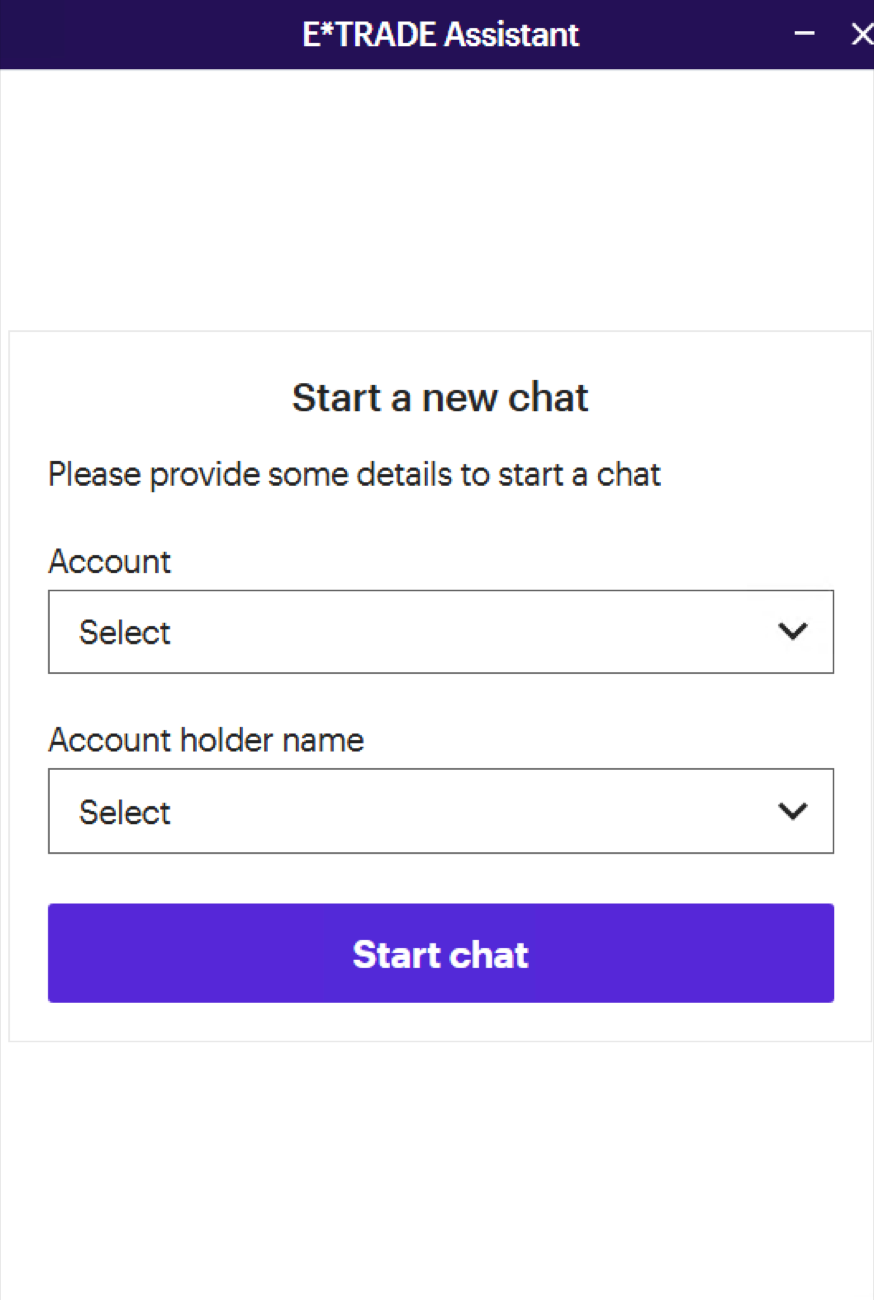
Frictionless escalation with context pre-collected so users don't repeat themselves.
Balances, holdings and activity shown directly in the chat window.
Timely, tailored content built on top of the foundational capabilities.
07 · Desktop VA Benchmark
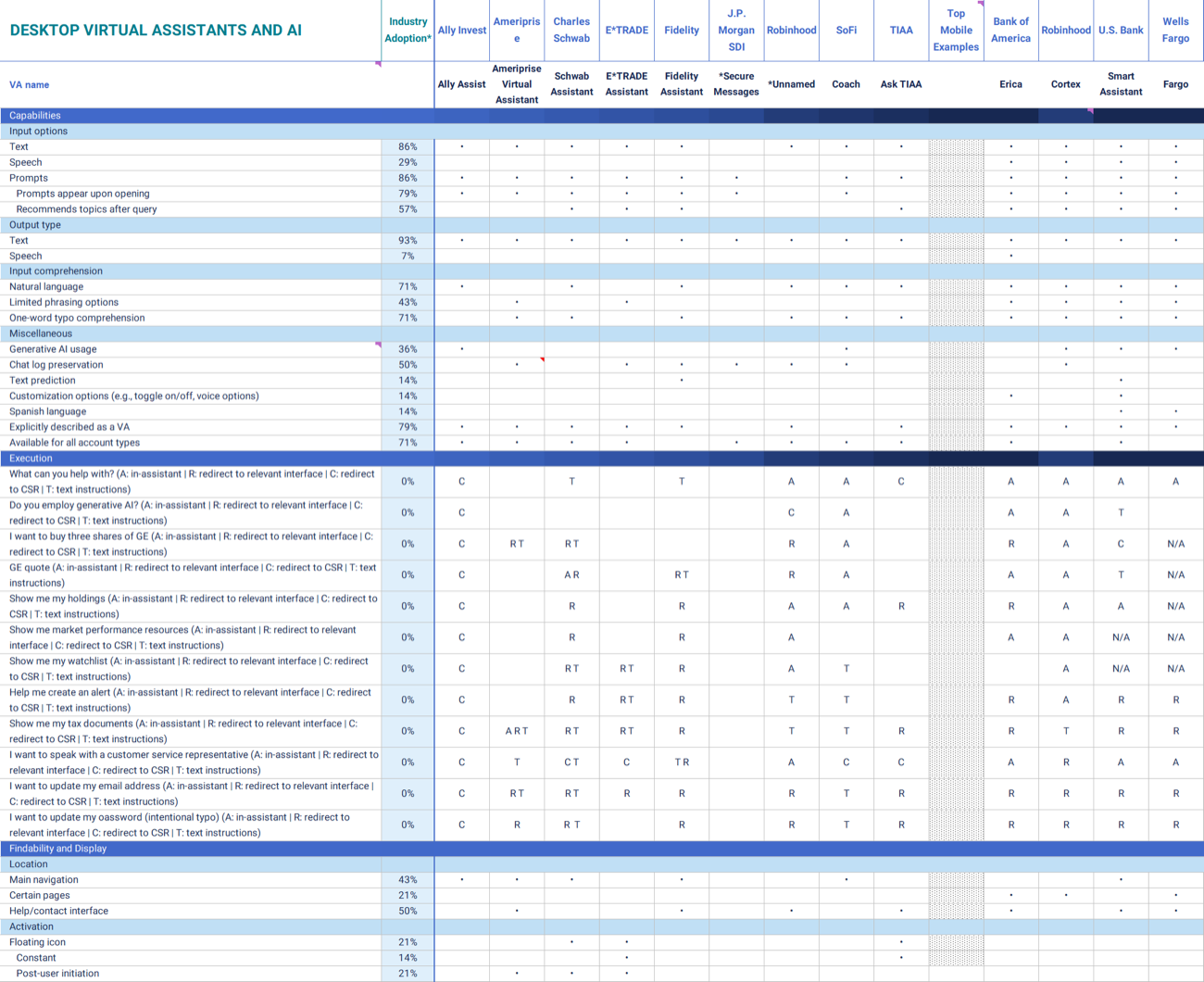
Corporate Insight tested a consistent set of prompts across nine desktop brokerage VAs plus four leading mobile assistants. The pattern is stark: two AI-powered tools pull far ahead of the deterministic field.
| Prompt | Ally | Ameriprise | Schwab | E*TRADE | Fidelity | JPM | Robinhood | SoFi | TIAA | BofAM | RobinhoodM | U.S. BankM | Wells FargoM |
|---|---|---|---|---|---|---|---|---|---|---|---|---|---|
| What can you help with? | — | N | Y | N | Y | — | Y | Y | N | Y | Y | Y | Y |
| Do you employ generative AI? | — | N | N | N | N | — | N | Y | N | Y | Y | N | N |
| Buy three shares of GE | — | P | P | N | N | — | P | P | N | P | Y | N | N |
| GE quote | — | N | Y | N | Y | — | Y | Y | N | Y | Y | N | N |
| Show me my holdings | — | N | Y | N | P | — | Y | Y | Y | Y | Y | P | N |
| Market performance resources | — | N | Y | N | P | — | Y | N | N | Y | Y | N | N |
| Show me my watchlist | — | N | Y | Y | P | — | N | N | N | N | Y | N | N |
| Help me create an alert | — | N | Y | Y | Y | — | Y | Y | N | Y | Y | Y | Y |
| Show me my tax documents | — | Y | Y | Y | Y | — | Y | Y | Y | Y | Y | Y | Y |
| Speak with a representative | — | Y | Y | Y | Y | — | Y | Y | Y | Y | Y | Y | Y |
| Update my email address | — | Y | Y | Y | Y | — | Y | Y | Y | Y | Y | Y | Y |
| Update my password (typo) | — | Y | P | N | Y | — | Y | Y | Y | Y | Y | Y | Y |
M = mobile example. Ally funnels straight to live chat; J.P. Morgan Self-Directed Investing has no full VA (a Secure Messages tool instead). Highlighted columns are the AI-powered standouts.
firms — Robinhood & SoFi — replaced deterministic VAs with AI that holds multi-turn, account-aware conversations.
incumbent brokerage VAs could fully place a trade — and only two could route a client to their watchlist.
of firms place the VA in the main navigation — a fundamental findability gap even for capable tools.
of qualifying firms offered multi-modal responses — and none did so consistently.
08 · Areas of Opportunity
The most urgent problem isn't missing advanced capability. It's that much of what's already deployed underperforms on the basics that build trust.
Half of tested automated-investing and workplace-retirement VAs failed on a single-word typo. Robust NLP is achievable at scale — and quietly erodes trust when it's missing.
Only about half of firms put the VA in the main navigation. A capable tool nobody can find delivers no value — Robinhood's strong VA is curtailed by poor findability.
Pairing an in-assistant answer with a link and brief instructions accommodates more users — yet fewer than half of qualifying firms do it, and none consistently.
No automated-investing VA delivers personalized goal-related insights in-chat — a glaring gap for a model built entirely around reaching financial milestones.
Almost no insurance or retirement VAs disclose they're AI-powered (6% in banking). Disclosure is a low-cost, high-impact comfort driver being left on the table.
Users repeatedly cite re-explaining an issue after a handoff as a top frustration. Direct, in-assistant transitions that preserve context are strongly preferred.
09 · Industry Snapshots
AI deployment is nascent and uneven. VAs that surface account information remain the predominant form; analysis is the next frontier.
| Industry | AI Informs | AI Analyzes | AI Advises |
|---|---|---|---|
| Consumer banking | |||
| Brokerage | |||
| Automated investing | |||
| Insurance | |||
| Workplace retirement | |||
| Workplace financial wellness |
Gap: chatbots handle basic queries only; AI browsers can now act on authenticated sites.
Priority: reframe AI as a complement to human service; extend into budgeting & cash management.
Gap: client-facing GenAI nearly nonexistent; “advice” regulation raises the cost of missteps.
Priority: roll out GenAI in stages — contained use cases first, with transparent disclosure.
Gap: goal-related information is nearly absent — the core of the robo model.
Priority: connect VA experiences to goal tracking and portfolio data.
Gap: most AI investment is internal; advisor-facing deployment is early and narrow.
Priority: convert portfolio data into client-ready observations that free advisor time.
Gap: customer-facing chatbots vary widely; internal AI is far more mature.
Priority: guide coverage decisions and execute policy & claim functions with trust.
Gap: chatbots redirect rather than embed info; only four offer a mobile VA.
Priority: personalize with account-level data; make escalation consistent.
Gap: execution is uneven; many link to content rather than generate guidance.
Priority: conversational coaching that builds context and ties to the benefit package.
10 · The Path Forward
Incumbents' AI problem is execution. Trust is their advantage — and it must be earned on the experiences they've already shipped before building the next ones.
Building new capability on top of experiences that erode trust is a losing sequence. Improving existing VAs is a precondition for new features earning consumer confidence — not a maintenance task.
Only a minority choose a firm because it offers AI. The right internal metric is whether the customers already open to a good experience are getting one.
The mainstream consumer isn't the early adopter on an agentic-trading waitlist. 59% want no AI in placing trades. Build the capability calibrated to that reality — not the most advanced option available.
As firms converge on similar GenAI features, the contest shifts to how well the tool handles failure, discloses limits, and hands off to a human. That advantage is harder to copy than the technology.
“The firms best positioned to define what AI in financial services becomes are not those chasing the most advanced capabilities. They are those that have earned — through execution quality and attentiveness to how customers actually feel — the trust required to take the next step.”
— Corporate Insight, AI in Financial Services Today
Appendix
This briefing is an internal synthesis of the two Corporate Insight reports for leadership discussion. Figures and examples are drawn from the source studies; some chart values are shown at report-level precision.